

Updated on 09-06-2026: The blog was updated with data, facts, figures, and insights from latest studies released by the CFA Institute.
The growing demand for CFA-qualified professionals across India's finance industry has made compensation an important consideration for candidates, especially when salary outcomes vary by role, experience, city, and employer type. If you are also among the CFA career aspirants, this guide is going to help you with the indicative salary band of CFA qualified candidates in India across levels, roles, experience, industries and location.
Looking forward to pursuing CFA? Consider CFA coaching to align your preparation with hiring cycles.
CFA Salary Guide India: A Level-Wise Breakdown
At Levels 1 and 2, job roles tend to overlap across research, credit, and analytical roles, especially during early-career transitions. However, Level 3 often marks a transition into higher-responsibility roles, accompanied by a substantial increase in both base and variable pay.
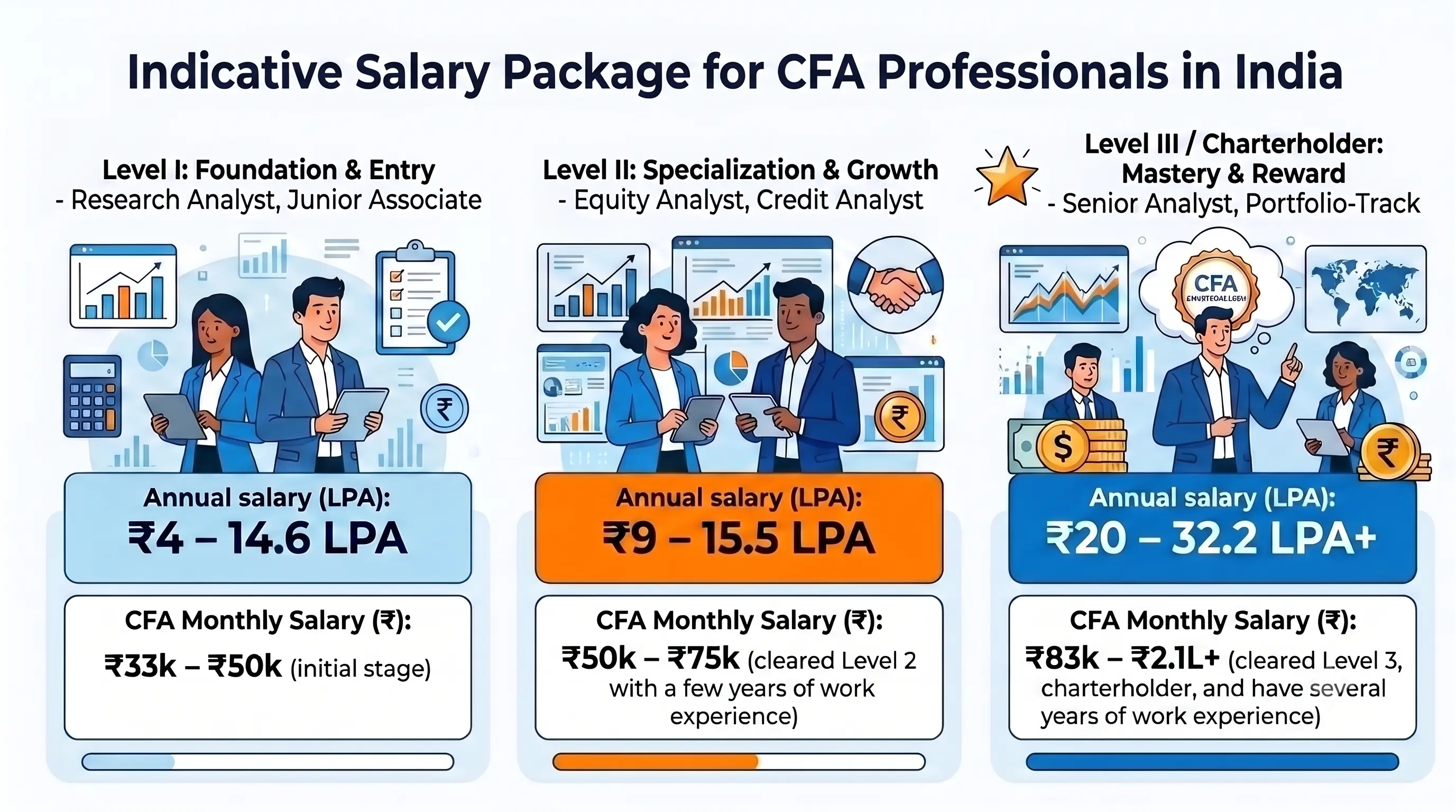
CFA Level 1: Some of the typical entry roles include junior associate, research analyst, and valuation/data roles. A realistic band is around ₹4–6 LPA, although Tier-2 entry points can start nearer ₹3–4.5 LPA. This roughly translates to ₹33,000–₹50,000 per month as a planning anchor for a CFA fresher's salary.
CFA Level 2: After passing Level 2, candidates can progress into equity or credit analyst roles with good bands at ₹6–9 LPA, with metros and front-office teams skewing higher — particularly where firms reward modelling, coverage depth, and writing/pitch quality.
CFA Level 3: After reaching Level III pass or the charterholder stage, compensation typically widens to ₹10–25 LPA+ in many market-aligned roles, while strong buy-side and front-office teams can go beyond ₹30–50 LPA+ depending on performance and bonus practices.
Curious about your expected salary after each CFA level? Explore the Salary Calculator.
Industry and Location Impact on CFA Salaries
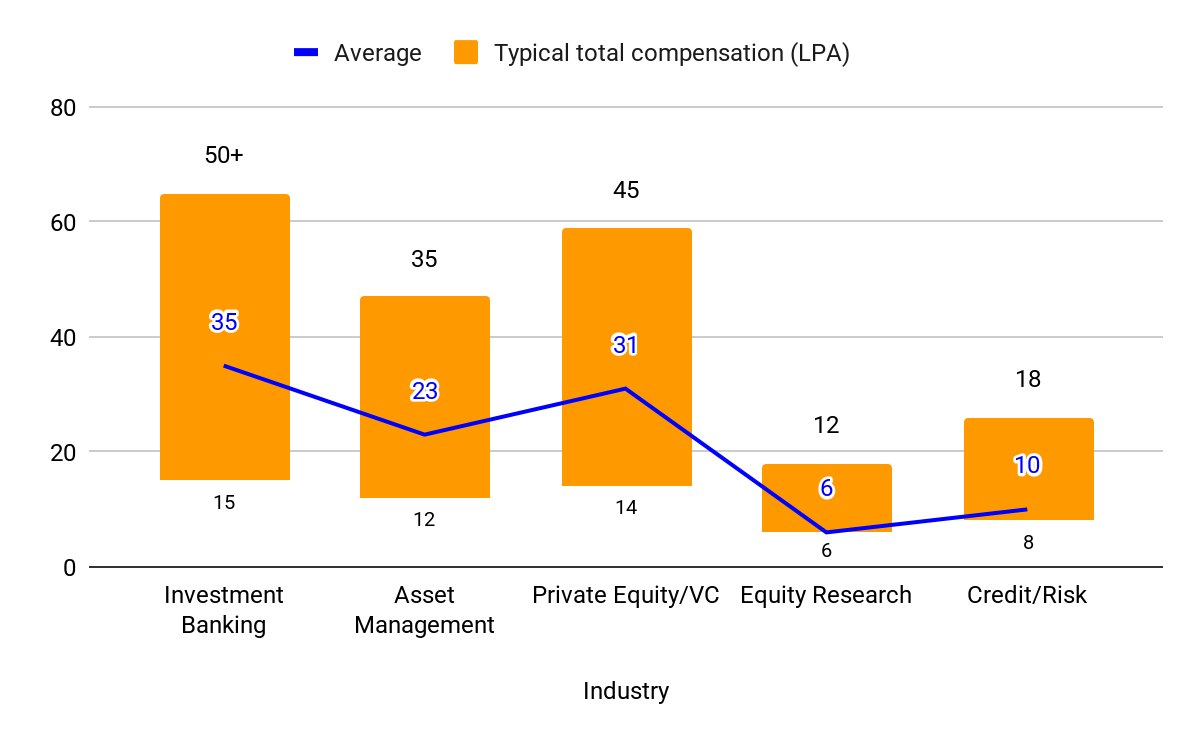
Industry matters significantly. Investment banking, asset management, and private equity typically offer higher base pay and much larger variable compensation, while credit rating, FP&A, and middle-office roles tend to have lower (though still reasonable) compensation. This is especially true at mid-to-senior levels in India. Here is a detailed breakdown.
Industry-Wise CFA Salary Range
| Industry | Typical Total Compensation (LPA) |
|---|---|
| Investment banking | ₹15–50 LPA+ |
| Asset management | ₹12–35 LPA |
| Private equity / VC | ₹14–45 LPA |
| Equity research | ₹6–12 LPA |
| Credit / risk | ₹8–18 LPA |
The company size also plays a significant role in determining salary structure. Established private equity platforms, global AMCs, and multinational banks usually pay more than small boutiques or startups on fixed pay. However, some startups can compensate with faster growth in responsibility and equity. Hence, candidates must benchmark both base and bonus potential by desk, not just headline salaries, when comparing offers.
Subsequently, cities are an additional factor in determining the salary range. Mumbai often offers 10–20% above national ranges, with Delhi NCR and Bengaluru following close behind. In comparison, Tier-2 cities pay less on average per comparable role. Here are some indicative CFA salary ranges across popular cities.
City-Wise CFA Salary Range
| City | Typical CFA-aligned Salary (LPA) |
|---|---|
| Mumbai | ₹12–30 LPA |
| Bengaluru | ₹10–25 LPA |
| Delhi NCR | ₹9–20 LPA |
| Pune | ₹8–18 LPA |
| Chennai | ₹7–15 LPA |
| Hyderabad | ₹7–16 LPA |
Growth Momentum for CFA Salaries in India
The growth momentum for finance professionals pursuing the CFA charter in India is remarkably strong, demonstrating substantial salary appreciation as candidates progress through the program levels and accumulate experience.
According to the CFA Institute 2026 Impact Study on Compensation and Career, here is how average annual compensation (in INR Lakhs) has shifted between 2022 and 2026 across different exam stages, alongside what candidates expect to earn after passing their next exam:
Current Annual Compensation of Respondents
Average annual compensation in INR Lakhs
| Candidate Level | 2022 Compensation (INR Lakhs) | 2026 Compensation (INR Lakhs) |
|---|---|---|
| Candidate Level I | ₹10.1 LPA | ₹14.6 LPA (with relevant work experience) |
| Candidate Level II | ₹13.5 LPA | ₹15.5 LPA (with relevant work experience) |
| Candidate Level III | ₹17.5 LPA | ₹17.1 LPA (with relevant work experience) |
| Candidate Level III Pass | ₹20.7 LPA | ₹19.4 LPA (with relevant work experience) |
Expected Annual Compensation of Respondents, After Passing their CFA Exam
Average annual compensation in INR Lakhs
| Candidate Level | 2022 Expected Compensation (INR Lakhs) | 2026 Expected Compensation (INR Lakhs) |
|---|---|---|
| Candidate Level I | ₹32.2 LPA | ₹28.7 LPA |
| Candidate Level II | ₹32.7 LPA | ₹30.6 LPA |
| Candidate Level III | ₹31.5 LPA | ₹31.7 LPA |
| Candidate Level III Pass | ₹31.0 LPA | ₹32.2 LPA |
Note: These are CFA Institute survey averages among respondents with varying experience, role, and location; they should not be read as freshers' salary bands.
CFA Candidates Compensation Growth
- Recently awarded charterholders (2024–2025): Average annual income of ₹32.4 lakh, with an average of 6.1 years of experience; the study reports this as an increase from ₹28.6 lakh in 2022.
- Overall CFA charterholders: Average annual income of INR 66.6 lakh, with an average of 9.8 years of experience.
- Long-term Growth: Over 70% of CFA Level III passouts with more than 8 years of experience earn more than INR 40 Lakhs annually.
Key Market Momentum Insights
- Tempering Increment Expectations: While a striking 69% of respondents received annual pay hikes of over 20% in the recent past, only 37% expect a similar high increment in the coming 12 months, indicating a cooling down of baseline salary hike expectations in the broader market.
- Perceived Progression Impact: 63% of respondents explicitly state that the CFA Program impacts their compensation progression. Interestingly, this sentiment is strongest among Level I candidates and scales lower as professionals reach the full charterholder stage.
- Geographic Hotspots: Location plays a heavy role in compensation growth momentum. Mumbai leads the country with nearly 40% of Level III passouts earning more than INR 50 Lakhs annually, followed by Delhi NCR and Bengaluru at 28%.
Comparison with Other Certifications
The CFA certification strongly signals expertise for valuation, markets, and portfolio management roles, particularly on the buy side. Other credentials such as FRM, MBA, CA, CPA, and ACCA focus on different specialisations, but when combined with the CFA, they can further enhance career outcomes and professional credibility.
CFA vs FRM Salary
Focus and Roles:
- CFA is geared toward careers in investment analysis, research, and portfolio management.
- FRM focuses primarily on market/credit/operational/treasury risk, as well as model risk, across banks, Asset Management Companies (AMCs), and Global Capability Centres (GCCs) in India.
Salary Ranges (Indicative) — CFA:
- Entry-level jobs cited a range of ₹6–14.6 LPA
- Mid-level being ₹13–15.5 LPA
- Senior-level roles reflecting ₹19.5–50 LPA+ in top teams with higher bonuses in IB/AM/PE roles.
Salary Ranges (Indicative) — FRM:
- Entry-level salaries cited a range of ₹9–12 LPA
- Senior roles reported ₹20–30 LPA or more. Some roles also reflected a range of ₹18–33 LPA in certain risk tracks, depending on the bank and experience.
CFA vs MBA Salary
Focus and Roles:
- CFA aligns with equity/credit research, portfolio management, product/strategy on the buy side.
- The MBA (Finance) program encompasses corporate finance, investment banking, consulting, and leadership tracks, with a focus on securing Tier-1 placements in India.
Salary Ranges (Indicative) — CFA:
- Level 1 between ₹6–14.6 LPA
- Level 2 between ₹13–15.5 LPA
- Level 3/Charterholder between ₹19.5–50 LPA+. Moreover, seasoned leaders can easily surpass ₹30–50+ LPA where variable pay is meaningful.
Salary Ranges (Indicative) — MBA:
- Freshers from reputable institutions often report median salaries of ₹12–20 LPA, with elite institutions like IIM/ISB reporting higher bands.
- In some instances, front-office investment banking/consulting can exceed ₹20 LPA plus bonuses at top schools.
CFA vs CA
Focus and Roles:
- CFA: Centres on investment analysis and portfolio roles with a stronger signal for buy-side/sell-side investment roles.
- CA: Specialises in accounting, audit, assurance, and tax. In India, CA dominates statutory and corporate accounting tracks.
Salary Ranges (Indicative) — CFA:
- Standard entry bands range from ₹6–14.6 LPA to ₹15–25 LPA+ at the charterholder level.
- Accordingly, top-end outcomes in investment banking/asset management/private equity leadership exceed ₹30–50 LPA, with variable pay, and select roles reach ₹1 crore+ over time.
Salary Ranges (Indicative) — CA:
- New CAs may get around ₹8–15 LPA.
- Mid-level ₹15–25 LPA
- Senior leadership/partner tracks ₹25–50 LPA+, with partners or owners potentially reaching ₹40 LPA to ₹1 crore+ depending on practice scale.
CFA vs CPA
Focus and Roles:
- CFA: Focus on markets and investments, aligning with research, asset management, and investment banking.
- CPA: Focused on accounting/financial reporting/audit-heavy (particularly US GAAP/SOX environments). In India, CPA aligns with Big 4, GCCs, and US-focused controllerships.
Salary Ranges (Indicative) — CFA:
- The average range is often cited as approximately ₹8 LPA, scaling to ₹15–20 LPA for mid-level and higher roles in front-office teams, with senior roles having wider dispersion due to bonuses and LTIs.
Salary Ranges (Indicative) — CPA:
- Average ₹7 LPA with senior roles citing between ₹20–30 LPA in some aggregations. They also enjoy growth with MNC/Big 4 roles.
CFA vs ACCA
Focus and Roles:
- CFA: Preferred for research, asset management and investment banking, covering investments and portfolios.
- ACCA: Spans accounting, audit, and advisory. In India, ACCA is increasingly used in shared services/Big 4 and corporate finance.
Salary Ranges (Indicative) — CFA:
- Entry to mid-level positions is often higher in front-office teams, with many salary guides citing ₹6–14.6 LPA averages, scaling to ₹15–25 LPA+ in investment roles, where senior ranges widen due to bonuses.
Salary Ranges (Indicative) — ACCA:
- Freshers enter into positions with a range of ₹3–8 LPA
- Mid-level ₹11–17 LPA
- Senior roles ₹19–30+ LPA depending on the firm/city. However, Big 4 tracks have clearer ladders.
CFA vs FRM, MBA, CA, CPA, ACCA — Roles & Salaries (India, Indicative)
| Aspect | CFA | FRM | MBA (Finance) | CA | CPA | ACCA |
|---|---|---|---|---|---|---|
| Focus & Roles | Investment analysis, equity/credit research, portfolio & product roles; buy-side & sell-side | Market/credit/operational/treasury risk, model risk across Banks, AMCs, GCCs | Corporate finance, IB, consulting, leadership tracks (esp. Tier-1 B-schools) | Accounting, audit, assurance, tax; statutory & corporate finance | Accounting, financial reporting, audit (US GAAP/SOX), Big 4 & GCCs | Accounting, audit, advisory, corporate finance; popular in Big 4/shared services |
| Entry Salary | ₹4–6 LPA (L1); ₹6–12 LPA in some tracks | ₹9–12 LPA | ₹12–20 LPA (higher for IIM/ISB) | ₹8–15 LPA | ~₹7 LPA | ₹3–8 LPA |
| Mid-Level Salary | ₹10–25 LPA (Charterholder/Level 3) | ₹18–25 LPA | ₹20+ LPA (IB/Consulting higher) | ₹15–25 LPA | ₹15–20 LPA | ₹11–17 LPA |
| Senior Salary | ₹26–50+ LPA (IB/AM/PE leaders often >₹1 Cr with bonuses) | ₹20–30+ LPA, some tracks ₹33 LPA | ₹25–50+ LPA depending on firm/role | ₹25–50+ LPA, Partners/Owners ₹40 LPA–₹1 Cr+ | ₹20–30 LPA (Big 4/MNC senior roles) | ₹19–30+ LPA (Big 4/corporates) |
Additional Combined-Path Insights
Most candidates are also curious about CFA salaries in combination with other certifications. According to consolidated reports from multiple sources, here is an indicative figure based on that data:
CFA + FRM:
- Entry-level ranges between ₹6–14.6 LPA
- Mid-level ₹12–20/25 LPA
- Senior-level ₹25–50 LPA+, with banks and asset management companies showing meaningful variable pay in treasury, market/credit risk, and investment risk seats. Additionally, the range widens by desk and city.
CFA + MBA:
- Freshers can earn a starter salary between ₹15–25 LPA
- Mid-level ranging between ₹18–32 LPA
- Senior roles ranging between ₹35–48 LPA, where MBAs (Tier-1) unlock placements and CFA certification helps deepen credibility in investment banking, asset management, and private equity. Moreover, the upside expands with bonuses/LTIs in front-office seats.
CFA + CA:
- When combined with CA, the role's focus moves into investment roles with entry salaries starting between ₹8–12 LPA
- Mid-level ranging between ₹15–28 LPA
- Senior-level ranging upwards of ₹30–50 LPA+. One can expect top-end outcomes in equity/credit research, as well as buy-side roles, where forensic financial statement analysis is highly valued. Upside depends on a successful desk transition.
CFA + CPA:
- CPAs often offer packages with entry-level salaries of ₹7–10 LPA.
- Mid-level ₹15–25 LPA
- Senior-level ₹30–35 LPA. Combining it with CFA can enhance prospects for equity/credit coverage, as well as investment roles, through stronger valuation/storytelling, particularly in US-GAAP-heavy or global firms.
CFA + ACCA:
- ACCA bands in India commonly cite ₹4–8 LPA for entry-level
- ₹11–17 LPA for mid-level
- ₹19–37 LPA for senior-level roles. Combining it with CFA can enhance outcomes when transitioning to equity/credit research or buy-side analysis. Moreover, the combined path premium is evident mainly after the role shift, rather than as an additive credential alone.
Joint Salary Ranges — CFA + Other Certifications (India, Indicative)
| Combo | Entry-Level | Mid-Level | Senior-Level | Notes / Role Focus |
|---|---|---|---|---|
| CFA + FRM | ₹6–14.6 LPA | ₹12–20/25 LPA | ₹25–50 LPA+ | Strong fit for banks & AMCs; treasury, market/credit/operational risk, investment risk; variable pay depends on desk & city. |
| CFA + MBA | ₹15–25 LPA | ₹18–32 LPA | ₹35–48 LPA+ | MBAs (Tier-1) open placements; CFA adds credibility in IB, AM, PE; upside expands via bonuses/LTIs in front-office roles. |
| CFA + CA | ₹8–12 LPA | ₹15–28 LPA | ₹30–50 LPA+ | Shifts CA career into investment-focused roles (equity/credit research, buy-side); forensic financial analysis valued. |
| CFA + CPA | ₹7–10 LPA | ₹15–25 LPA | ₹30–35 LPA | Advantage in US-GAAP-heavy/global firms; CFA adds value for equity/credit coverage & valuation skills. |
| CFA + ACCA | ₹4–8 LPA | ₹11–17 LPA | ₹19–37 LPA | CFA lifts ACCA into research/buy-side analysis; premium realized after transition rather than immediately additive. |
The Final Takeaway
The level-wise salary expectations for CFA aspirants in India are roughly ₹6 to 14.6 LPA at Level 1, ₹9 to 15.5 LPA at Level 2, and ₹10–19.5 LPA+ at Level 3/charterholder, with ₹30–50 LPA+ achievable for high performers. Moreover, higher brackets are possible in choosing senior investment roles over time in India's top markets. Aspirants who pair curriculum mastery with internships, demonstrate depth, possess strong writing/pitching skills, and target smart cities and desks tend to experience faster career acceleration and better resilience through market cycles in India.
Frequently Asked Questions (FAQs)
Citations:
- CFA Institute Graduate Outlook Survey 2026
- CFA Institute Impact Study on Compensation and Career
- CFA Institute FY2024 Annual Report
- CFA Institute Insights hub
- Salary Data from CFA Charterholder Surveys (India)
- Glassdoor India
- AmbitionBox
- RBI Financial Sector Reports
- World Bank India Data