

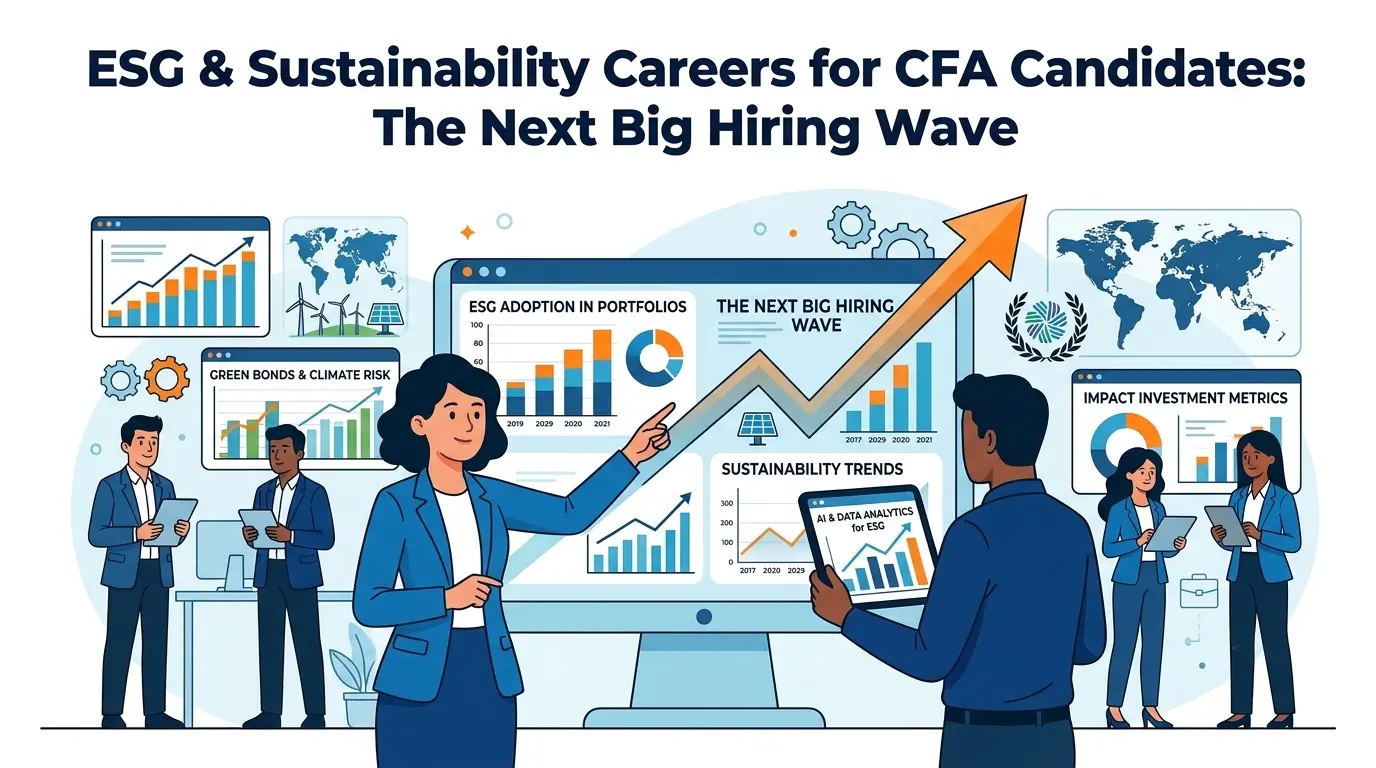
ESG and sustainability are no longer niche “nice-to-have” domains in finance. Across asset management, banking, insurance, and consulting, firms are embedding sustainability into research, risk, product design, and reporting. This shift is expanding the number of roles that value a CFA-style skill set.
For CFA candidates, this creates a clear opportunity. You already train for valuation, risk, and ethics: the same foundations increasingly required in sustainable investing and climate risk roles. As ESG moves closer to capital allocation and regulatory scrutiny, finance-trained candidates with credible sustainability exposure are becoming more valuable, not less.
Key Takeaways
- ESG hiring is expanding across finance, not just sustainability teams, creating multiple entry points for CFA candidates.
- ESG careers split into distinct tracks such as ESG integration, stewardship, climate risk, sustainable finance, and reporting.
- CFA skills in valuation, risk analysis, and ethics translate directly into ESG roles that influence investment decisions.
- Entry into ESG is fastest when candidates pick one track, build proof of work, and network with hiring managers in that niche.
- ESG roles increasingly command pay premiums and faster responsibility when they sit close to investment or risk teams.
Why ESG Hiring Is Growing Fast
As more banks, asset managers, insurers, and consulting firms use sustainability in their work, ESG skills are becoming more valuable. People who can connect its factors to valuation and investment decisions now have an increasing edge because of the following reasons.
ESG Is Moving Into Core Finance Teams
What used to be a niche sustainability function is now part of the mainstream finance workflow. Asset managers, banks, insurers, and consulting firms increasingly want professionals who can connect ESG factors to valuation, risk, governance, and long-term performance. As a result, the roles are showing up in more places than just dedicated sustainability departments.
Financial Services Are Driving ESG Hiring
Financial services have become one of the most consistent hiring engines for ESG talent. The reason is simple: firms must now respond to regulation, investor scrutiny, disclosure expectations, and the need to assess its risks in portfolios and balance sheets. Even in slower hiring markets, ESG roles tied to reporting, compliance, and capital decisions tend to stay relevant.
Climate Risk Is Now a Financial Issue
Climate risk is no longer treated as a soft or purely narrative topic. Physical risks, transition risks, and policy changes can affect revenue, margins, asset values, and discount rates. That makes ESG work much closer to standard investment analysis, which is why candidates with valuation, risk, and accounting skills are increasingly valuable.
CFA Certificate Updates Strengthen the ESG Career Link
CFA Institute’s latest certificate updates make the connection between ESG skills and finance careers even clearer. The Certificate in ESG Investing was renamed the Sustainable Investing Certificate, while the Climate Risk, Valuation, and Investing Certificate was introduced for professionals who want deeper expertise in climate-finance work.
These updates matter because they show how ESG is evolving from a broad sustainability theme into a more finance-focused skill set. The Sustainable Investing Certificate is designed to help investment professionals integrate ESG factors into investment decisions, while the climate-risk certificate focuses on climate science, transition finance, valuation impacts, scenario analysis, and portfolio management.
For CFA candidates, this is an important signal. Employers are not just looking for general interest in sustainability; they want people who can connect ESG and climate factors to valuation, risk, and capital allocation. That is exactly where CFA training gives candidates an advantage.
Info:
Take the first step to building your finance career with CFA Level 1.
ESG Career Paths for CFA Candidates
Rather than thinking in job titles, it is more useful to view ESG careers through the problems they solve and the finance skills they require.
| ESG Roles | Primary Problem Solved | Key CFA / Finance Skill Applied |
| ESG Research & Integration | Identifying financially material ESG risks and opportunities | Financial statement analysis, valuation, risk-return framing |
| Stewardship & Active Ownership | Improving governance and long-term risk outcomes | Ethics, governance analysis, long-term investor judgment |
| Sustainable Finance & Products | Structuring ESG-linked financing and products | Fixed income logic, cash flow analysis, client communication |
| Climate Risk & Valuation | Translating climate risks into valuation and portfolio impact | Scenario analysis, discount rate adjustment, risk modeling |
| ESG Data & Reporting | Ensuring consistent, audit-ready ESG disclosures | Analytical discipline, reporting rigor, data interpretation |
For CFA candidates, this matters because many ESG roles sit close to core investment work. If you already understand accounting, valuation, ethics, and risk, you already have a strong base for ESG integration, sustainable investing, and climate risk analysis. The real advantage comes when you can apply those finance skills to ESG issues that affect performance, not just commentary.
ESG Career Growth and Salary Trends in India
Compensation in ESG careers varies widely by role, firm, and location, but the strongest pay is usually found in jobs that sit close to investment decisions, risk management, or climate analysis.
Recent India-focused salary snapshots suggest that ESG and sustainability analyst roles typically begin around ₹4–8 LPA at the entry level, while climate risk roles are often reported in the ₹5–8 LPA fresher band, with faster growth once the role becomes more specialized or finance-linked.
Why finance-linked ESG roles pay better
ESG roles are not all paid the same. Positions that support ESG research, climate risk, sustainable investing, or stewardship often command stronger compensation because they influence valuation, portfolio construction, governance, or credit decisions.
By contrast, roles centered mainly on reporting or disclosure usually grow more slowly unless they evolve into assurance, analytics, or investment-facing work.
Entry-level salary range in India
For CFA candidates entering ESG careers in India, the most defensible public salary data points place entry-level compensation roughly in the ₹4–8 LPA to ₹6–9 LPA range for ESG and sustainability analyst roles, with climate risk analyst roles commonly starting around ₹5–8 LPA.
Higher offers are more likely when the role is attached to asset management, banking, consulting, or another finance-heavy team rather than a pure reporting function.
Career growth and progression
Career growth tends to be faster when ESG work is embedded in core finance functions such as investment research, portfolio risk, or sustainable finance. In those settings, professionals can move from analyst to senior analyst or associate-level responsibilities more quickly because their work affects capital allocation, risk assessment, and decision-making.
Industry salary guides also suggest that mid-career ESG roles can move into the ₹12–20 LPA range, while senior specialist and assurance-oriented roles can go higher depending on the firm and the level of responsibility.
Info:
Curious about how much can CFA candidates earn in India? Feel free to try our CFA salary calculator tool to get a brief idea.
How CFA Skills Apply to ESG Roles
CFA candidates already bring a strong foundation to ESG careers because the CFA curriculum trains you to think for various things. Those same skills are highly relevant in ESG roles where the goal is not to talk about sustainability in general, but to understand what affects value, risk, and long-term performance. They can be broadly classified into the following.
Materiality thinking, not just opinion
CFA training teaches you to focus on what actually matters to financial outcomes. In ESG work, that is a major advantage because not every sustainability issue has the same impact on cash flows, risk, or company value. Employers value candidates who can separate meaningful ESG factors from noise and connect them to investment decisions.
Valuation and scenario logic
Many ESG and climate risks show up in familiar finance variables such as revenue growth, operating margins, capex, and discount rates. CFA candidates already understand how to think through these drivers, which makes it easier to assess how ESG issues affect valuation. Instead of treating ESG as a separate subject, you can translate it into the language of finance.
Ethics and governance awareness
Governance and stewardship roles rely heavily on judgment, transparency, and accountability. That makes the CFA emphasis on ethics especially useful in ESG careers. Candidates who can assess governance quality, disclosure standards, and long-term decision-making are often better prepared for roles tied to active ownership and responsible investing.
Structured communication
ESG professionals often need to explain complex judgments to portfolio managers, clients, regulators, or internal committees. CFA candidates usually have an edge here because the program builds a habit of clear, structured thinking. That matters when you need to present ESG risks, defend a valuation view, or summarize a recommendation in a way that decision-makers can quickly use.
Info:
Learn more about finance professionals skills currently in demand in the industry.
How CFA Candidates Can Become ESG-Ready
To become ESG-ready, CFA candidates need to show proof of work, understand the right tools, and use certifications to strengthen their profile.
1. Pick one ESG track
Choose one area and go deep instead of trying to cover everything. Good options include:
- ESG research.
- Climate risk.
- Stewardship and active ownership.
- Sustainable finance.
2. Build proof of work
Create 2–3 practical outputs that show your thinking and analysis. Examples include:
- An ESG-integrated equity note.
- A climate risk memo.
- A sustainable finance pitch deck.
- A reporting dashboard on material ESG issues.
3. Use credentials as support
Certificates can help, but they should back up your practical work, not replace it. Relevant options include:
- CFA Institute’s Sustainable Investing Certificate.
- CFA Institute’s Climate Risk, Valuation, and Investing Certificate.
4. Learn the ESG tool basics
You do not need to be a data engineer, but you should be comfortable with:
- Excel.
- ESG datasets.
- Disclosure frameworks.
- ESG scores and their limitations.
5. Focus on financial impact
Employers value candidates who can explain how ESG affects:
- Valuation.
- Risk.
- Portfolio decisions.
- Capital allocation.
This structure makes you more hireable because it shows both interest and application. ESG employers look for candidates who can connect sustainability with real finance decisions.
Conclusion
ESG careers are becoming a lasting part of finance hiring, especially in roles where sustainability connects with valuation, risk, and capital allocation. For CFA candidates, this is less about switching paths and more about applying existing finance skills to a fast-growing area.
The candidates who do best in ESG are the ones who combine sustainability awareness with strong financial thinking. If you build that mix through solid CFA preparation and practical ESG knowledge, you will be better placed to show employers the kind of rigor they want.
Info:
Need more help in deciding your career? Fill out the form below and we’ll get in touch with you for counseling.
FAQs
Q: What ESG jobs are best suited for CFA candidates?
A: CFA candidates fit best into ESG integration, stewardship, climate risk, and sustainable finance roles where financial judgment matters more than narrative reporting.
Q: Is the CFA ESG certificate still called the Certificate in ESG Investing?
A: No. CFA Institute renamed it the Sustainable Investing Certificate in April 2025. The curriculum remains the same, but candidates should use the updated name on resumes.
Q: What’s the difference between the Sustainable Investing and Climate Risk certificates?
A: The Sustainable Investing Certificate focuses on ESG integration in investment decisions, while the Climate Risk, Valuation, and Investing Certificate focuses specifically on climate-related valuation and portfolio impacts.
Q: What skills matter most for ESG hiring?
A: Employers look for proof of applied capability. Pick a track and demonstrate valuation integration, risk logic, stewardship reasoning, or reporting discipline rather than only stating interest.