
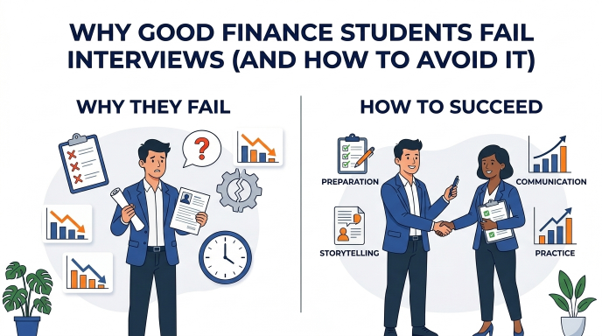
You have cleared difficult exams. You understand accounting concepts, financial statements, valuation methods, and financial ratios. You have the qualifications employers look for.
Yet after the interview, you receive the same email:
“We’ve decided to move forward with another candidate.”
It’s frustrating because you know you’re capable. The problem is that finance interviews are rarely just tests of technical knowledge.
Interviewers are trying to answer a bigger question: Would this person solve problems, communicate clearly, and work well with the team?
That’s why two candidates with similar knowledge can leave the same interview with very different outcomes. The one who gets hired isn’t always the one who knows the most. It’s often the one who understands what the interviewer is really evaluating.
Once you see interviews from that perspective, your preparation changes. Instead of memorising answers, you focus on demonstrating your thinking, communicating with confidence, and connecting your skills to the role.
Let’s explore what hiring managers really look for, why capable students often miss out, and how you can prepare for your next finance interview with confidence.
Key Highlights
- Understand what finance interviewers are really evaluating beyond technical knowledge.
- Learn how to prepare for both technical and behavioural interview questions with confidence.
- Discover how to connect your skills and experiences to what employers are looking for.
- Find practical ways to handle nervousness, mistakes, and questions you don’t know the answer to.
- Build an interview strategy that helps you stand out from equally qualified candidates.
Every Finance Interview Is About Four Questions
Whether you’re interviewing for investment banking, FP&A, equity research, audit, or corporate finance, every interview may look different. But interviewers are usually trying to answer the same four questions:
- Can this person do the job?
- Can they learn quickly?
- Can I trust them?
- Would I want to work with them every day?
Almost every question is designed to answer one or more of these.
Technical questions assess your finance knowledge. Questions about internships, projects, or challenges reveal how you think and solve problems. And questions like “Tell me about yourself” or “Why this company?” test your communication, preparation, and motivation.
Once you understand what interviewers are actually evaluating, preparing becomes much easier. Instead of memorising answers, you can focus on demonstrating the qualities employers genuinely look for.
Info:
Explore how much you can earn with a CFA certification with our CFA Salary Calculator Tool.
Why Good Candidates Still Miss Out
The gap is not always about knowledge. More often, it’s the inability to translate that knowledge into a strong interview performance.
It’s like a cricketer who scores heavily in the nets but struggles during a match. The skill exists, but performing under pressure is a different challenge. Finance interviews work the same way. They test not just what you know, but how well you can apply that knowledge, explain your thinking, and communicate with confidence when it matters.
Many candidates spend weeks revising accounting standards, valuation techniques, and financial ratios but very little time preparing to explain their thought process or connect their experiences to the role. Others become so focused on giving the “right” answer that they forget interviewers are also evaluating how they think, learn, and collaborate.
The good news is that these skills can be developed. Like technical concepts, they improve with practice. The first step is understanding what interviewers are actually trying to evaluate.
Info:
Think you’re interview-ready? Watch this investment banking mock interview to get detailed insights.
Study the Job Description, Not Just the Interview
Before preparing your answers, understand the role. Identify the key skills, responsibilities, and tools required.
For every skill you already have, prepare a real example. Instead of saying, “I know Excel,” explain how you’ve used it in a project or internship.
If you spot a skill gap, start learning it. Saying, “I’ve recently started learning Power BI because this role requires it,” shows initiative.
Finally, be clear about why you want the role and how your skills can add value. The strongest answers connect what the company needs, what you’ve done, and how you can contribute.
Don’t Let Small Mistakes Shake Your Confidence
Everyone fumbles occasionally. A pause, a repeated word, or taking a moment to think won’t cost you the job. Panicking about it might.
If you need a moment, simply say, “Let me rephrase that” or “Let me think about that for a second.”
And if you don’t know an answer, don’t fake it. Be honest and explain how you would approach the problem. A logical thought process often impresses interviewers more than a confident but incorrect answer.
Practice Through Mock Interviews
Reading interview questions is useful, but speaking your answers aloud is more effective. Arrange mock interviews with a friend, teacher, mentor, or senior. Ask them to conduct the session like a real interview.
Mock interviews can help you improve:
- Confidence
- Speaking speed
- Body language
- Answer structure
- Ability to think under pressure
You should also record yourself answering questions on your phone. While reviewing the recording, check:
- Am I speaking too quickly?
- Am I using too many filler words?
- Is my answer clear?
- Is my answer too long?
- Do I maintain eye contact?
- Do I appear confident?
Do not try to correct everything at once. Focus on one or two areas during each practice session.
You can also watch interview videos or speak to seniors who have completed finance interviews. Observe how they structure their answers, explain technical concepts, and handle difficult questions.
Do not copy their answers. Learn from their approach and adapt it to your own experience.
Info:
For more insights, check out our blog on Why do students fail CFA.
Research the Company
Be ready to answer, “What do you know about our company?” Research its business, industry, recent developments, and the role you’re applying for. Also prepare 2–3 thoughtful questions for the interviewer. It shows you’ve done your homework and are genuinely interested in the opportunity.
Quick Finance Interview Tips
- Start preparing 1–2 weeks in advance, covering technical concepts, the job description, company research, and mock interviews.
- Prepare a 60-second introduction highlighting your education, skills, experience, and interest in the role.
- Strengthen your fundamentals first, then move to advanced concepts, using examples from projects, internships, or certifications.
- For online interviews, test your camera, microphone, internet, lighting, and background beforehand.
- Keep your résumé and the job description handy during the interview.
- Prepare 2–3 thoughtful questions to ask the interviewer.
- Review difficult questions after every interview and improve before your next opportunity.
The Final Takeaway
A finance interview is ultimately a conversation about potential.
Your qualifications, certifications, and technical knowledge may earn you an interview, but they don’t earn you the offer. Employers are trying to understand how you think, how you approach problems, and whether you’ll continue to grow after joining the organisation.
Don’t measure a successful interview by the number of questions you answered correctly. Measure it by whether you gave the interviewer confidence that you could learn, contribute, and be trusted with responsibility.
Because careers aren’t built by knowing everything. They’re built by demonstrating that you’re ready for what’s next.
Info:
Still unsure of how to prepare for your interview? Fill out this form so that our experts can reach out to you for personal guidance.
FAQs
Q: What are the common finance interview mistakes?
A: The biggest mistakes are memorizing answers, bluffing, poor communication, and not researching the company. Interviews test your judgment as much as your technical knowledge.
Q: How do I answer “Tell me about yourself”?
A: Keep it structured: your background, your interest in finance, and why you’re a good fit for the role. Don’t simply repeat your resume.
Q: How do I answer “Why this company?”
A: Show you’ve researched the company. Explain what attracts you about the role, the firm’s work, and how it aligns with your career goals.
Q: What should I say if I don’t know the answer?
A: Be honest. Explain how you would approach the problem instead of guessing. Interviewers value logical thinking over bluffing.
Q: What are the top finance interview questions for freshers?
A: Expect questions like: Tell me about yourself, Why finance?, Why this company?, Financial statements, Valuation basics, Current market trends, Strengths & weaknesses, and Resume-based questions.