
You want to break into finance, but your degree says engineering, computer science, or something completely unrelated.
And suddenly, every finance job description seems to ask for a finance degree.
That does not mean you are locked out. But you do need to close the gap between what you studied and what the role requires. It is simply finance knowledge, relevant skills and some proof that you can apply them.
So the real question isn't whether you have a finance degree. It's whether you can show you're ready for the finance role you want.
Start With the Role, Not the Qualification
Finance is not one career, it is multidimensional. An engineering graduate with strong quantitative skills could explore risk, financial analytics, fintech or quantitative finance.
A computer science graduate could combine programming with finance in fintech, data or risk. Someone from a humanities or communications background may need to build more technical finance knowledge but could explore areas such as wealth management, operations or client-facing roles.
The important thing is to choose a direction before trying to learn everything.
| Target Finance Role | Skills to Start Building |
|---|---|
| Investment Banking | Accounting, Excel, financial modelling and valuation |
| Equity Research | Accounting, valuation, financial markets and research |
| Financial Analysis | Financial statements, Excel and financial modelling |
| FP&A | Accounting, Excel and financial forecasting |
| Risk Management | Statistics, risk management, Excel and Python/SQL |
| FinTech | Finance, Python, SQL and data analytics |
| Wealth Management | Financial markets, financial planning and communication |
You do not need to master every skill before applying for your first role. You need enough relevant knowledge to show that you understand the work.
ℹ️ Want to know about the skills in detail?
Check out our detailed guide on the list of skills to help you stand out in the finance job market.
Build the Finance Fundamentals
If you did not study finance in your graduation, start by closing the obvious knowledge gap.
Before building a career in Finance, you should be comfortable with:
- Income statements, balance sheets and cash flow statements
- Revenue, profitability, debt and working capital
- Time value of money and cost of capital
- Stocks, bonds, mutual funds and interest rates
- Risk, return and diversification
- Basic valuation
- Inflation, interest rates and economic cycles
One skill that deserves particular attention is financial statement analysis.
In CFA Institute's 2026 research of 500 finance-sector professionals in management roles, 61% identified financial statement analysis as a technical skill new finance professionals should be able to perform confidently from day one. Excel proficiency followed at 51%.
That is a useful reality check. You do not need to begin with advanced derivatives or complicated Python models. First, learn to understand what a company's numbers are actually saying.
Add the Technical Skills Your Role Needs
Once you have the basics, build skills around your target role.
For many entry-level finance roles, Excel remains important for analysis, forecasting and modelling. Depending on the role, you may then add financial modelling, valuation, SQL, Python, Power BI or other data skills.
This combination is becoming more important as finance becomes more data-driven. CFA Institute's 2026 employer research found that financial employers increasingly want AI, coding and data skills alongside traditional financial analysis, judgement and communication. It also notes that Excel-based financial modelling remains important.
The point is not to collect a list of tools. Learn the tool because the role needs it.
Knowing Python without understanding finance will not automatically make you a finance candidate. Likewise, knowing Excel formulas is not the same as being able to build or interpret a financial model.
Build Evidence Before You Have the Job
This is where many career switchers get stuck. They have taken courses, earned certificates and watched finance content, but their CV still does not show that they can actually apply what they learned.
You can start building that evidence before your first finance job.
For example:
- Analyse a listed company's financial statements.
- Build a basic DCF valuation.
- Write a short equity research report.
- Create a financial dashboard.
- Analyse a company's credit position.
- Build a simple financial model.
You do not need ten projects. Two or three strong, well-explained projects are more useful than a folder full of certificates.
For each project, be ready to explain what you did, why you made your assumptions and what your analysis actually tells you.
That gives you something concrete to discuss in interviews.
Get Experience Any Way You Can
Internships are one of the clearest ways to bridge the experience gap.
Look beyond only investment banks. Depending on your interests, consider banks, NBFCs, fintech companies, research firms, wealth-management firms, consulting, corporate finance teams, GCCs and risk functions.
CFA Institute also recommends internships for people looking to build financial skills, understand the industry and demonstrate their capabilities.
If an internship is not immediately available, projects, finance competitions, research work and relevant part-time opportunities can still give you something to show.
The goal is simple: move from “I am interested in finance” to “Here is what I have done in finance.”
Do You Need CFA?
Not necessarily. But for someone without a finance degree, a structured qualification can help build knowledge and signal that you are serious about the field.
The CFA Institute identifies the CFA Program as one route to developing investment knowledge and lists areas such as investment analysis, financial reporting, economics, quantitative methods, equity, fixed income, and portfolio management within the program.
You also do not need a finance degree to enter the CFA Program. CFA Institute eligibility allows candidates to qualify through a bachelor's degree, certain undergraduate timelines, or a combination of higher education and professional work experience.
But a qualification is not a substitute for experience.
CFA + no practical skills is still a weak story. If you pursue it, connect what you learn to the role you want and demonstrate that knowledge through projects, internships and interviews.
Don't Ignore Communication
Finance is not just spreadsheets.
CFA Institute's July 2026 research found that soft skills, including communication, collaboration and teamwork were the biggest skills gap identified among new finance professionals. Soft skills were also identified by 67% of respondents as the skillset that makes professionals most employable in finance today.
So practise explaining your work.
- Can you explain why revenue changed?
- Can you defend a valuation assumption?
- Can you turn a spreadsheet into a clear conclusion?
A useful habit is to ask “So what?” after every analysis. You found that margins fell. So what does that mean for the business?
That ability to connect numbers to a business decision is what turns technical knowledge into finance thinking.
Your Degree Is Not the Problem
When you come from a non-finance background, interviewers will naturally ask: “Why finance?”
Do not answer with, “I've always been interested in finance.” Rather, explain the connection.
Your previous background → the skills you developed → what exposed you to finance → the role you became interested in → what you have done to prepare.
For example, an engineer might connect analytical problem-solving to an interest in company analysis, then point to a financial modelling or valuation project they completed.
Your previous degree does not have to disappear from your story. Keep in mind that the strongest career switch is not about pretending you started from zero. It is about showing how your existing skills can become useful in a new field.
A Practical Roadmap
If you are starting today, keep the process simple:
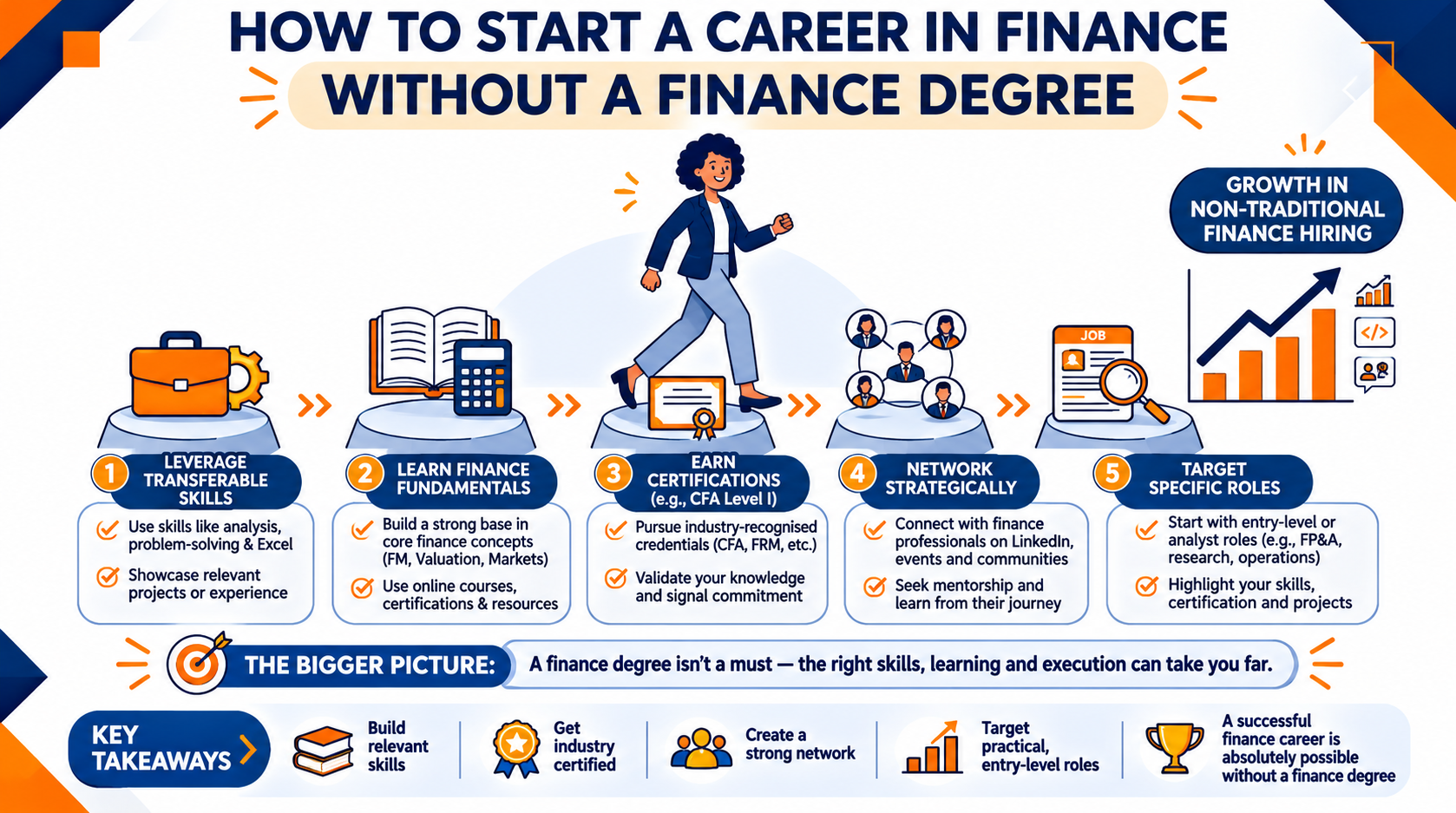
1. Pick one finance role.
Do not start by trying to learn all of finance.
2. Identify the skill gaps.
Compare your current skills with what that role requires.
3. Learn the fundamentals.
Start with accounting, financial statements, markets and basic valuation.
4. Build role-specific skills.
Excel, modelling, Python, SQL, research or whatever your target role actually needs.
5. Create 2–3 relevant projects.
Make your learning visible.
6. Get practical experience.
Apply for internships and relevant entry-level opportunities.
7. Build your network.
Speak to people already doing the work. Ask about the role, skills and hiring process, not just for a job.
8. Apply with a finance-focused CV.
Translate your previous experience into skills relevant to finance.
You do not need to become a finance expert before you can call yourself a finance candidate. You need to show knowledge, skills, evidence and direction. A non-finance background cannot be the barrier to a career in finance.
The Takeaway Point
A non-finance degree may mean you have to build some knowledge from scratch, but it does not decide your career for you.
What matters is whether you can understand the role, build the skills it requires and show that you can apply them. Your degree is where your career started. It does not have to determine where it goes.
FAQs
Q: Can I get a finance job without a finance degree?
A: Yes. Graduates from engineering, computer science, mathematics, humanities and other disciplines can enter finance. You need relevant finance knowledge, technical skills and practical evidence of your ability to apply them.
Q: Which finance jobs can I pursue without a finance background?
A: Depending on your existing skills, you can explore:
- Engineering: Risk management, quantitative finance.
- Computer Science: FinTech, financial analytics.
- Mathematics: Quantitative analysis, financial modelling.
- Humanities: Wealth management, financial operations, client-facing roles.
Q: Is CFA useful for someone without a finance degree?
A: Yes. The CFA Program builds knowledge of investment analysis, financial reporting, economics and portfolio management. It can strengthen your profile, but should be complemented with practical projects and relevant experience.
Q: What skills should I learn to switch to finance?
A: Start with accounting, financial statements, economics, financial markets and valuation. Depending on your target role, develop skills in Excel, financial modelling, Python, SQL, Power BI and data analytics.
Q: How can I get finance experience without prior work experience?
A: Build practical projects such as company analysis, financial modelling, valuation or equity research. Also apply for internships at banks, NBFCs, fintech companies, research firms and corporate finance teams.
ℹ️ Still have questions?
Fill out the form below and our counselors will guide you through starting your finance journey